Universal Quantum Unveils Integrated Ion-Trap Processor for DLR Systems
Universal Quantum announced its integrated quantum processing unit, or iQPU, on November 3, positioning the chip as a way to address the wiring and connectivity problems that complicate large trapped-ion computers. The UK-based company, which also operates in Hamburg, says the module will be used in two systems it is building for the German Aerospace Center, DLR. That identified destination makes the announcement more concrete than a standalone laboratory concept, although performance in those systems remains to be demonstrated.
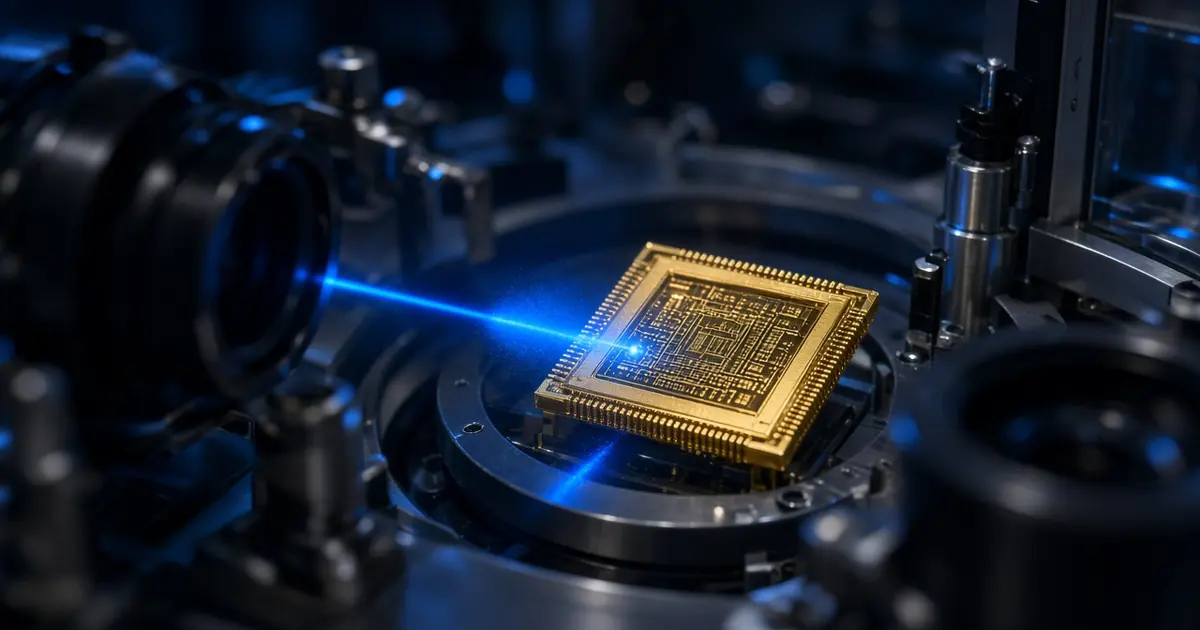
The processor combines a trapped-ion compute surface, control electronics and chip-to-chip interfaces in one design. Universal Quantum reports an active computing area exceeding 400 square millimeters and describes it as the largest trapped-ion compute surface. The size claim is the company’s; it should not be interpreted as an independently verified ranking across every competing architecture.
The chip follows a quantum charge-coupled device approach, usually abbreviated QCCD. Instead of keeping every ion fixed in one position, the architecture moves ions among zones so qubits can be brought together for operations. That matters because quantum algorithms often require interactions between qubits that are not neighbors in a simple layout. Physical movement can offer flexible connectivity, though transport speed, heating and operation fidelity all influence whether the approach produces a practical advantage.
Universal Quantum has also integrated custom application-specific control circuitry, or ASICs, into the stack. Conventional scaling can require an increasingly awkward collection of external signal lines as more qubits are added. Bringing some switching and control closer to the processor is intended to reduce that burden. It does not eliminate the need for lasers, vacuum hardware, calibration or other supporting systems, but it addresses one important source of engineering complexity.
The third element is UQConnect, the company’s interface for linking neighboring modules. Universal Quantum says ions can move directly between modules, allowing several chips to behave as a larger system without redesigning the base unit. This is a different modularity proposition from architectures that rely entirely on optical links between separately housed quantum processors. It may simplify some operations if reliable transport between modules can be maintained at scale.
Manufacturing is another noteworthy part of the announcement. DesignQuantum reports that the iQPU is made on a 200-millimeter production line. Using an established wafer format is relevant to repeatability, process control and potential supply-chain development. Yet wafer size alone says nothing about usable chip yield or the number of working qubits delivered. Those metrics will become essential if Universal Quantum attempts to produce many identical modules.
The DLR deployment gives the project an immediate engineering test. Integrating the modules into two complete systems will require coordination among trapping hardware, electronics, control software and error-management techniques. The relevant milestones are not just successful manufacturing but stable operation, repeatable gate performance and useful multi-qubit computations across the designed connections.
Universal Quantum’s announcement arrives as developers of superconducting, trapped-ion and other architectures pursue different ways to build larger machines. There is no settled winner, and a claimed connectivity benefit must ultimately be judged alongside noise, speed, manufacturing yield and the resources required to correct errors. An ion chip with excellent routing could still face limitations elsewhere in the system.
For now, the company has disclosed a defined hardware package: a more-than-400-square-millimeter trapped-ion surface, integrated control ASICs, UQConnect interfaces and a planned role in two DLR machines. The next question is how those features perform together under sustained operation. Publishing measured gate fidelities, transport error rates and system uptime would make it possible to judge whether the integration is a practical step toward larger fault-tolerant quantum computers.