Alice & Bob Reports Multi-Hour Bit-Flip Lifetimes on Cat-Qubit Hardware
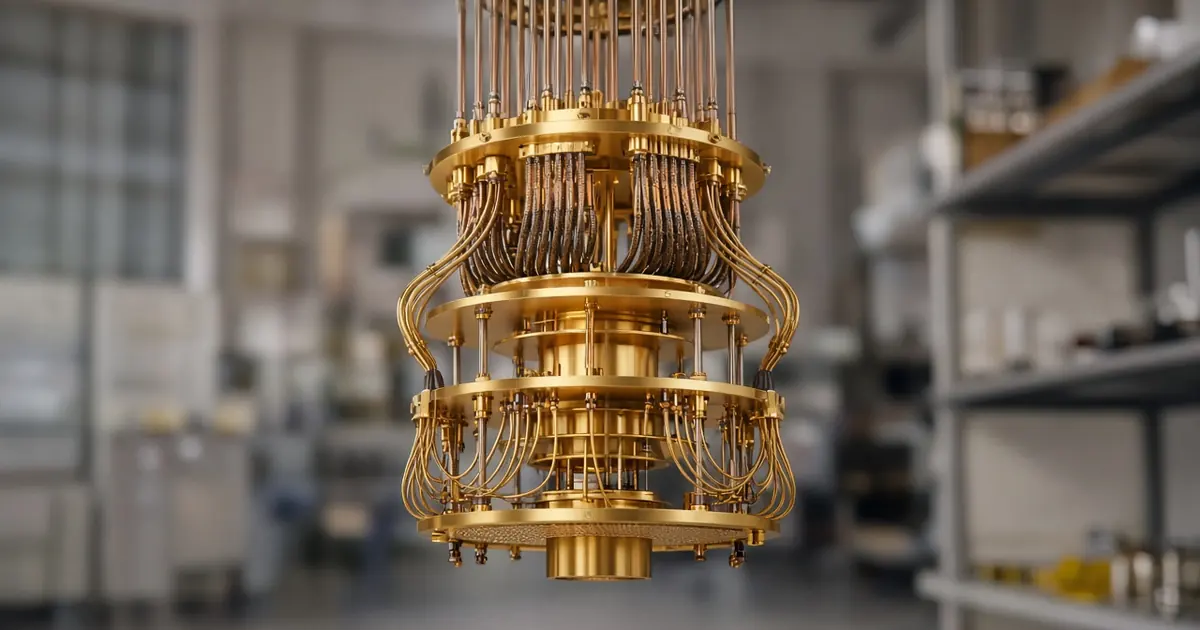
French quantum hardware developer Alice & Bob has reported unusually long idle bit-flip lifetimes in experiments on its superconducting cat-qubit technology. A technical update covered by Quantum Computing Report on November 2 describes an average 44-minute lifetime on a single-qubit device, with selected qubits on the company’s 12-qubit Helium 2 processor showing lifetimes measured in hours. The result is important for the firm’s error-correction strategy, but it does not mean that an entire quantum computation can run for hours without errors.
The single-device experiment monitored the system continuously for 61 hours and recorded 41 discrete quantum jumps. Quantum Computing Report lists a mean bit-flip lifetime of 44 minutes and a 95% confidence interval of 33 to 60 minutes, with an average occupation of 11 photons. These are statistical measurements of a specific error process during idle operation, not a general-purpose qubit coherence time.
On Helium 2, a 12-qubit processor, the reported idle bit-flip lifetimes included 189 minutes for one qubit, 252 minutes for another and 189 minutes for a third. The photon occupation in those tests ranged from 11 to 16. Those multi-hour figures indicate that the suppression effect can appear in a multi-qubit environment, although the data reported do not establish identical performance for every qubit or under every operating condition.
Cat qubits encode information in superpositions of coherent states in superconducting microwave cavities. The design uses engineered two-photon dissipation to suppress bit flips as the cat state grows. The tradeoff is that another error channel, phase flips, can become more prominent. This asymmetry is the central idea behind Alice & Bob’s approach: if one type of error is made very rare, the remaining correction problem may become simpler.
The tradeoff is visible in the company’s own measurements. Quantum Computing Report lists a phase-flip lifetime of 420 nanoseconds in a parity-decay measurement on the single-qubit device, corresponding to a single-photon T1 of 9.2 microseconds. The team also demonstrated resonant-drive Z rotations, reporting a 94.2% gate fidelity for a 26.5-nanosecond operation. Those numbers are not interchangeable with the long idle bit-flip lifetime. They illustrate why quantum-computing claims must specify which operation and error channel were measured.
The new data also connect to Alice & Bob’s earlier resource estimates for breaking RSA-2048 with Shor’s algorithm. A previous compilation discussed roughly 22,593 physical qubits under an idealized 100-year bit-flip lifetime assumption. With a more realistic once-per-hour physical bit-flip rate and an additional outer correction layer, the modeled requirement rose to roughly 45,000 qubits. The November experiments provide evidence relevant to the hour-scale assumption, not evidence that the proposed RSA-breaking computer has been built.
The next bottleneck is maintaining favorable error behavior during entangling operations. A useful fault-tolerant processor must perform repeated two-qubit gates, measure error syndromes and correct mistakes while computations proceed. Idle stability alone cannot demonstrate that capability. In particular, bias-preserving controlled-NOT operations and active logical error correction remain milestones identified in the reporting.
The significance of the result is therefore precise. Alice & Bob has produced experimental measurements that support one of the physical assumptions behind its error-correction architecture. The company has not shown that every relevant gate achieves the same suppression, that logical error rates are below useful thresholds, or that its proposed large-scale processor is imminent.
For researchers and prospective partners, the most valuable follow-up will be side-by-side data on idle and active error rates, reproducibility across larger arrays, and logical-qubit performance under a complete correction cycle. Those measurements will determine whether multi-hour protection against one error channel can translate into the much broader reliability required for commercially useful quantum computing.